
Cantonese lessons for beginners
Learning Cantonese is one of the most rewarding language journeys you can take. Whether you want to connect with family, travel to Hong Kong, or enjoy Cantonese media in its original language, these beginner lessons will give you a solid foundation. Each lesson includes real Cantonese words with Jyutping romanization so you know exactly how to pronounce every character.
Before we dive in, a quick note about Jyutping: it's the standard romanization system for Cantonese, developed by the Linguistic Society of Hong Kong. Each syllable is followed by a number from 1 to 6 indicating the tone. Once you learn to read Jyutping, you can pronounce any Cantonese word accurately even if you've never heard it before.
Lesson 1: greetings and basic expressions
Every language journey starts with learning how to greet people. Cantonese greetings are warm and practical, and you'll use these phrases every single day.
The most essential greeting is 你好 (nei5 hou2), which means "hello." You'll hear this everywhere, from shops to restaurants to phone calls. It's polite and works in any situation. In the morning, you can say 早晨 (zou2 san4), meaning "good morning." This is commonly used among colleagues, neighbors, and friends before noon.
Cantonese has two important words for "thank you," and knowing when to use each one is essential:
- 多謝 (do1 ze6): used when someone gives you a gift, compliment, or something tangible. Think of it as "thank you for something you gave me."
- 唔該 (m4 goi1): used when someone does something for you, such as holding a door or serving your food. It also functions as "excuse me" or "please" when getting someone's attention or making a request.
Here are more essential everyday expressions:
- 再見 (zoi3 gin3): goodbye
- 拜拜 (baai1 baai3): bye bye (casual, borrowed from English)
- 對唔住 (deoi3 m4 zyu6): sorry, excuse me
- 冇問題 (mou5 man6 tai4): no problem
- 好 (hou2): good, okay, yes
- 唔好意思 (m4 hou2 ji3 si1): sorry to bother you, excuse me (polite)
To introduce yourself, you can say 我叫 (ngo5 giu3) followed by your name. For example, "我叫 David" (ngo5 giu3 David) means "My name is David." To ask someone's name, say 你叫咩名 (nei5 giu3 me1 meng2), meaning "What is your name?"
A useful phrase when you're still learning is 我唔識講廣東話 (ngo5 m4 sik1 gong2 gwong2 dung1 waa2), meaning "I don't know how to speak Cantonese." Or if you want to express that you're learning, say 我學緊廣東話 (ngo5 hok6 gan2 gwong2 dung1 waa2), meaning "I'm learning Cantonese." Native speakers almost always respond with encouragement when they hear this.
Lesson 2: numbers from one to ten and beyond
Numbers are fundamental to daily life: shopping, telling time, giving your phone number, and understanding prices. Cantonese numbers follow a very logical system, and once you learn one to ten, you can construct any number.
Here are the numbers from one to ten:
- 一 (jat1): one
- 二 (ji6): two
- 三 (saam1): three
- 四 (sei3): four
- 五 (ng5): five
- 六 (luk6): six
- 七 (cat1): seven
- 八 (baat3): eight
- 九 (gau2): nine
- 十 (sap6): ten
Building larger numbers is straightforward. Eleven is 十一 (sap6 jat1, literally "ten one"). Twenty is 二十 (ji6 sap6, "two ten"). Twenty five is 二十五 (ji6 sap6 ng5, "two ten five"). One hundred is 一百 (jat1 baak3), and one thousand is 一千 (jat1 cin1). The system is remarkably logical compared to English.
An important note: when counting objects or ordering items, Cantonese uses a special counting word 兩 (loeng5) instead of 二 (ji6) for the number two. So "two cups of tea" would be 兩杯茶 (loeng5 bui1 caa4), not 二杯茶. You'll also need measure words (classifiers) between numbers and nouns, but we'll cover those in later lessons.
Cultural note: the number 八 (baat3, eight) is considered very lucky in Cantonese culture because it sounds similar to 發 (faat3), meaning prosperity. The number 四 (sei3, four) is considered unlucky because it sounds like 死 (sei2), meaning death. You'll notice many buildings in Hong Kong skip the fourth floor entirely.
Lesson 3: ordering food and dim sum vocabulary
Food is at the heart of Cantonese culture, and dim sum is its crown jewel. Learning food vocabulary is not only practical but also one of the most enjoyable parts of studying Cantonese. These phrases will help you navigate restaurants, street food stalls, and tea houses with confidence.
Let's start with essential restaurant phrases:
- 我想要 (ngo5 soeng2 jiu3): I would like...
- 幾多錢 (gei2 do1 cin2): how much does it cost?
- 買單 (maai5 daan1): the bill please (literally "buy the bill")
- 好好食 (hou2 hou2 sik6): very delicious
- 食飯 (sik6 faan6): to eat a meal (literally "eat rice")
- 飲茶 (jam2 caa4): to drink tea / to go for dim sum
- 唔辣 (m4 laat6): not spicy
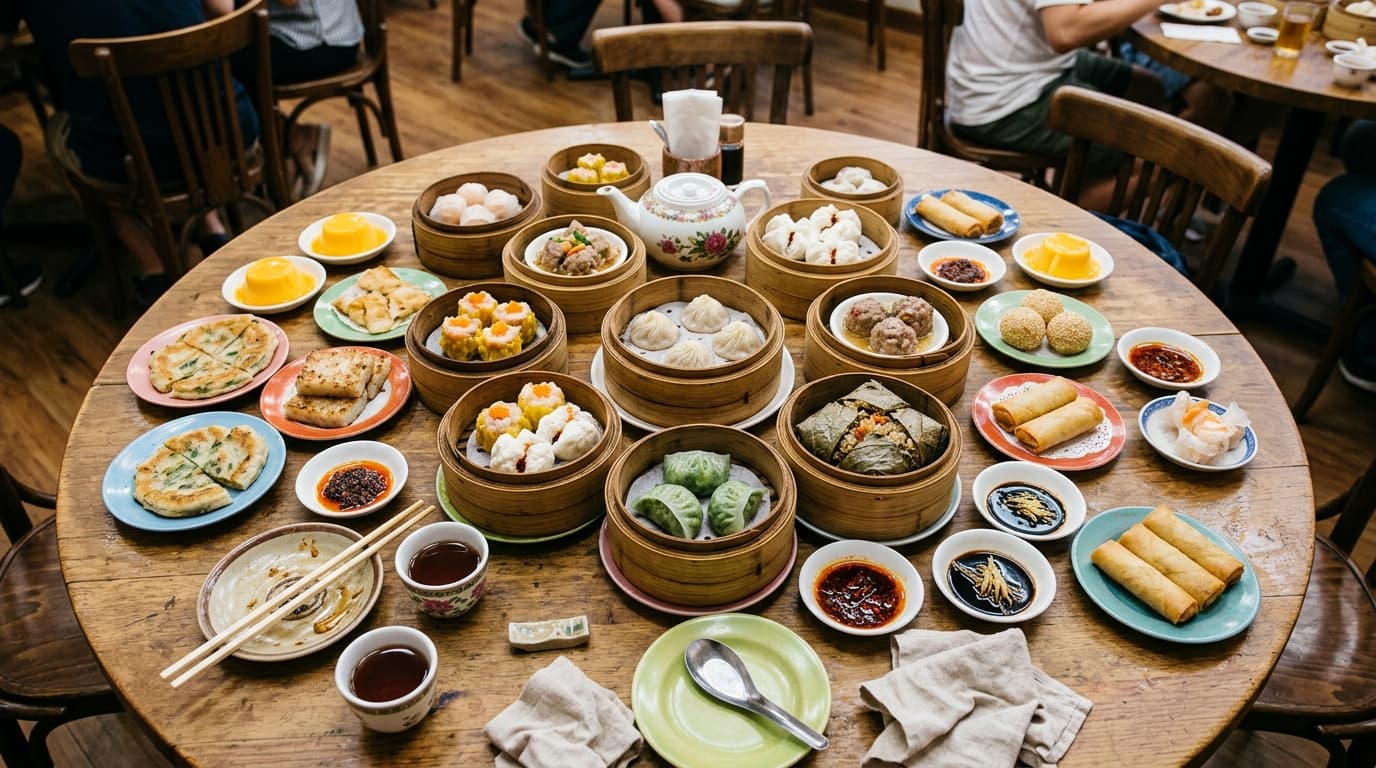
Now for the fun part: dim sum vocabulary. 點心 (dim2 sam1) literally means "touch the heart," and these small dishes are central to Cantonese dining culture. Here are the most popular items you'll encounter:
- 蝦餃 (haa1 gaau2): shrimp dumplings, the king of dim sum
- 燒賣 (siu1 maai2): pork and shrimp dumplings
- 叉燒包 (caa1 siu1 baau1): BBQ pork buns
- 腸粉 (coeng2 fan2): rice noodle rolls
- 蛋撻 (daan6 taat1): egg tarts
- 鳳爪 (fung6 zaau2): chicken feet
- 蘿蔔糕 (lo4 baak6 gou1): turnip cake
Common drinks you might order include 茶 (caa4, tea), 凍檸茶 (dung3 ning4 caa4, iced lemon tea), 奶茶 (naai5 caa4, milk tea), and 啤酒 (be1 zau2, beer). Hong Kong style milk tea is a cultural institution, and ordering 一杯奶茶 (jat1 bui1 naai5 caa4) is a great way to practice.
To put it all together, you might say: 唔該,我想要兩個蝦餃同一杯奶茶 (m4 goi1, ngo5 soeng2 jiu3 loeng5 go3 haa1 gaau2 tung4 jat1 bui1 naai5 caa4), meaning "Excuse me, I would like two shrimp dumplings and one milk tea."
Lesson 4: asking questions
Being able to ask questions is crucial for any language learner. Cantonese question words are straightforward and once you learn them, you can start having real conversations.
Here are the essential question words:
- 咩 (me1): what? Example: 你食咩 (nei5 sik6 me1) means "What are you eating?"
- 邊度 (bin1 dou6): where? Example: 廁所喺邊度 (ci3 so2 hai2 bin1 dou6) means "Where is the bathroom?"
- 幾多 (gei2 do1): how many / how much? Example: 幾多錢 (gei2 do1 cin2) means "How much money?"
- 邊個 (bin1 go3): who? Example: 佢係邊個 (keoi5 hai6 bin1 go3) means "Who is he/she?"
- 點解 (dim2 gaai2): why? Example: 點解唔去 (dim2 gaai2 m4 heoi3) means "Why not go?"
- 幾時 (gei2 si4): when? Example: 你幾時嚟 (nei5 gei2 si4 lai4) means "When are you coming?"
- 點樣 (dim2 joeng2): how? Example: 點樣去 (dim2 joeng2 heoi3) means "How do I get there?"
Yes/no questions in Cantonese are formed differently from English. Instead of changing word order, you create a choice between the positive and negative forms of the verb. For example, to ask "Do you want it?" you say 你要唔要 (nei5 jiu3 m4 jiu3), which literally translates as "you want not want." Similarly, "Is it good?" is 好唔好 (hou2 m4 hou2, "good not good"). This pattern is consistent across Cantonese and is one of the first grammar rules worth memorizing.
Some practical questions for daily life include: 呢個係咩 (ni1 go3 hai6 me1, "What is this?"), 你識唔識講英文 (nei5 sik1 m4 sik1 gong2 jing1 man2, "Can you speak English?"), and 邊度有港鐵站 (bin1 dou6 jau5 gong2 tit3 zaam6, "Where is the MTR station?").
Lesson 5: time and dates
Understanding time expressions lets you make plans, schedule meetings, and navigate daily life. Cantonese time vocabulary is logical and builds on the numbers you already learned.
Basic time words include:
- 今日 (gam1 jat6): today
- 聽日 (ting1 jat6): tomorrow
- 尋日 (cam4 jat6): yesterday
- 而家 (ji4 gaa1): now
- 朝早 (ziu1 zou2): morning
- 晏晝 (aan3 zau3): afternoon
- 夜晚 (je6 maan5): evening, night
To tell time, use 點 (dim2) for the hour and 分 (fan1) for minutes. Three o'clock is 三點 (saam1 dim2). Three thirty is 三點半 (saam1 dim2 bun3, using 半 meaning "half"). Three fifteen is 三點十五分 (saam1 dim2 sap6 ng5 fan1).
Days of the week follow a simple pattern using 星期 (sing1 kei4, "week") plus a number: 星期一 (sing1 kei4 jat1, Monday), 星期二 (sing1 kei4 ji6, Tuesday), all the way to 星期六 (sing1 kei4 luk6, Saturday). Sunday is the exception: 星期日 (sing1 kei4 jat6, using 日 meaning "day" instead of a number).
Months work the same way: 月 (jyut6, month) preceded by a number. January is 一月 (jat1 jyut6), February is 二月 (ji6 jyut6), and so on through December, 十二月 (sap6 ji6 jyut6).
Useful time phrases for making plans: 幾點 (gei2 dim2, "what time?"), 我哋幾時見 (ngo5 dei6 gei2 si4 gin3, "when shall we meet?"), and 下個星期 (haa6 go3 sing1 kei4, "next week").
Tips for practicing what you've learned
These five lessons give you a strong starting vocabulary and the ability to handle basic social interactions, shop, eat, ask questions, and discuss time. Here are some tips to make the most of what you've learned.
Practice speaking out loud every day, even if it's just to yourself. Cantonese is a tonal language, and your mouth and ears need regular practice to get comfortable with the six tones. Read the Jyutping, say the word, and pay attention to the tone number.
Use spaced repetition to review vocabulary. Research consistently shows that reviewing words at increasing intervals is the most effective way to move them into long term memory. Apps like YumCha build spaced repetition directly into their learning system, so you're always reviewing words at the optimal time.
Label objects around your house with Cantonese words. Stick a note on your door that says 門 (mun4, door), on your fridge saying 雪櫃 (syut3 gwai6, refrigerator), or on your cup saying 杯 (bui1, cup). This creates passive exposure throughout your day.
Listen to Cantonese as much as possible. Watch Hong Kong dramas with subtitles, listen to Cantopop songs, or follow Cantonese language YouTube channels. Even before you understand everything, exposure to natural speech helps your brain internalize the rhythm, tones, and patterns of the language.
Next steps on your Cantonese journey
These beginner lessons are just the starting point. As you continue learning, you'll discover more about Cantonese grammar, expand your vocabulary, and start having real conversations. The key topics to tackle next include measure words (classifiers), sentence final particles, past and future tense markers, and more complex sentence structures.
If you want a structured path that takes you through all of these topics and more, the YumCha app offers a complete Cantonese curriculum from beginner to advanced. Each lesson builds on what you've learned before, with interactive exercises, tone training, and speech recognition to ensure you're not just reading Cantonese but actually speaking it correctly.
Remember, consistency beats intensity. Fifteen minutes of Cantonese practice every day is more effective than a three hour session once a week. Set a daily goal, stick with it, and you'll be amazed at how quickly you progress. Cantonese may have a reputation as a difficult language, but with the right resources and consistent effort, it's absolutely achievable. 加油 (gaa1 jau4)!
Related grammar guides
- ParticlesSentence particles add tone, emotion, and nuance. Learn the most common particles in Cantonese and how to use them.
- NegationHow to say no, not, didn't, and don't in Cantonese. The four main negation words and when to use each one.
- Aspect markersCantonese has no tenses, but it does have aspect markers. Learn how zo2, gwo3, gan2, and hai2 dou6 show completion, experience, and ongoing action.
Related articles

Learning Cantonese for domestic helpers in Hong Kong: a practical guide
A practical guide to learning enough Cantonese for daily work as a domestic helper in Hong Kong, covering the home, the market, and family care.

Essential Cantonese phrases for new Hong Kong residents
The essential Cantonese phrases that make your first months in Hong Kong easier, grouped by the everyday situations you will actually meet.

Learning Cantonese as an expat in Hong Kong: a realistic guide
A realistic guide for expats in Hong Kong on learning enough Cantonese to make daily life easier, with the survival phrases that matter most.